Still life in daylight only
Studio
Aug 7, 2026
Jonas Weber
Studio
Still life in daylight only
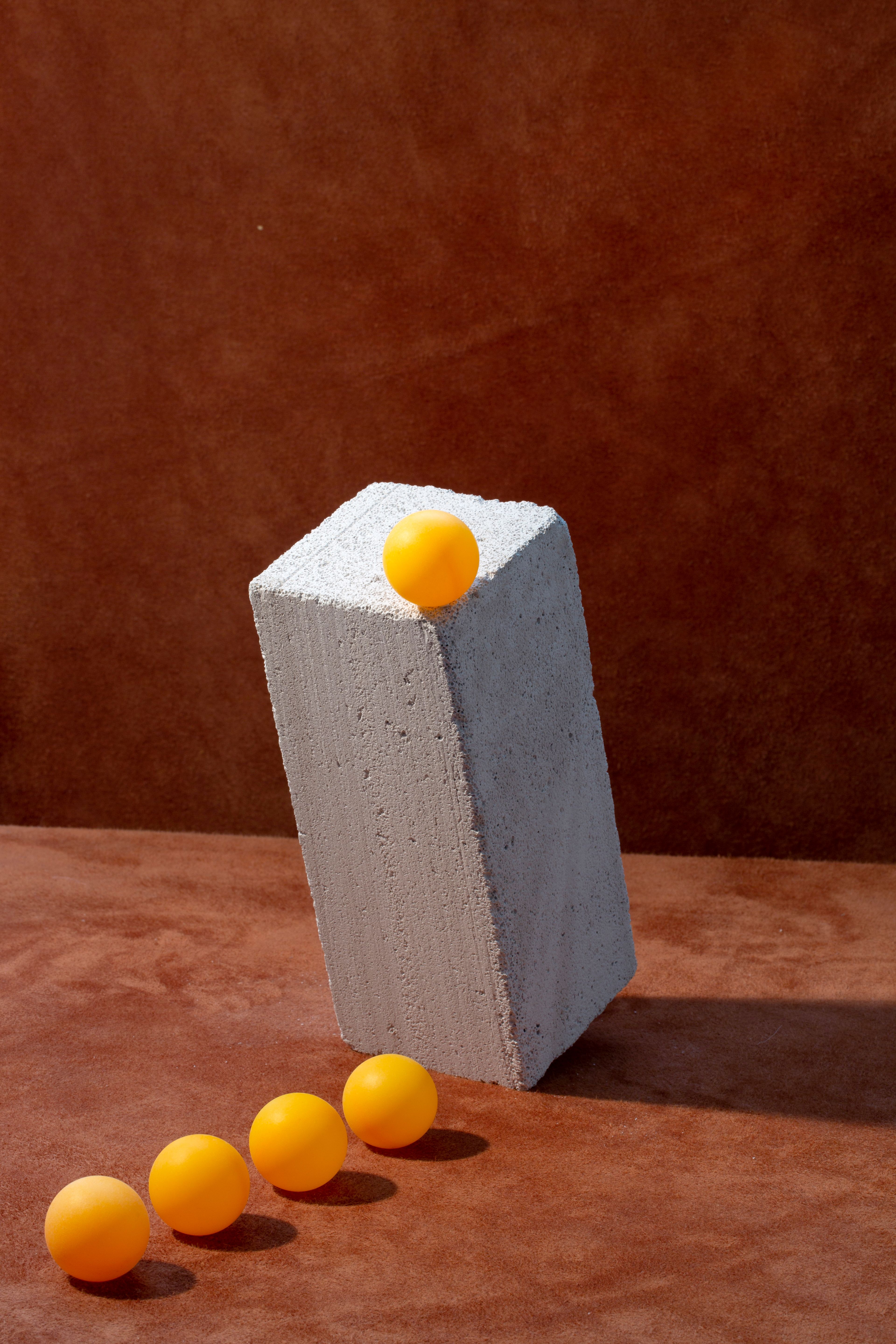
Fig. 01
No strobes for a year: what changed in the Balance series when the window became the only light.
The studio has one tall north window, and for a year it was the only light I used. My strobes went into the cupboard by the door, stands folded and cables wound, and the door stayed shut.
I expected the pictures to change. What I didn’t expect was how much the days would change with them.
The Balance series is what came out of that year: one object, one support and one colour that shouldn’t be there, lit by whatever the sky over Hamburg was doing that afternoon.
Why the strobes went in the cupboard
Strobes are honest tools. They give the same light at nine in the morning and at midnight, which is exactly what a client wants when a run of pictures has to match.
For my own work, that sameness had started to bother me. Every set looked as if it had been made in one room on one day, mostly because it had.
So I gave myself one rule for a year: no light I could switch on. If the window gave me nothing, I made nothing that day and wrote down why in the notebook.
The rule cost me some days. Hamburg in November can go a week with barely enough daylight to read by at noon, and those weeks went on printing, reading and moving objects around without a camera.
What a north window does all day
A north window never lets the sun in directly, which is why painters have always wanted one. The light it gives is soft and wide, coming from the whole sky rather than from a single point.
Because mine is tall, daylight arrives from above as well as from the side. Every object gets a top that glows a little and a base that sinks into shadow.
Nothing about it stays still, though. It drifts slowly enough that you don’t notice until a picture you were happy with stops working, and by then the change is an hour old.
Hamburg helps in its own way. A grey day here is the softest light I know, steady from late morning into the afternoon, while broken cloud makes the room brighten and dim every few minutes. On those days I wait for one state of the sky and shoot only in that.
The seasons move it too. In December the useful hours shrink to a few around noon; in June the window works from breakfast until well into the evening.
Fewer sets, each one shot for longer
A set that works at eleven is wrong by two. The shadows have swung round, the colour has cooled, and an object that looked balanced now seems to lean. So I stopped trying to build several sets in a day and built one, properly.
Morning: building the set
I build while the sky is still brightening, for the light I’ll have at its steadiest rather than what’s in the room now. The order never changes:
Place the support where the light falls evenly.
Add the object and turn it until one shadow reads clearly.
Bring in the colour that shouldn’t be there, last of all.
Look through the camera, wait ten minutes, then look again.
The fourth step is the one that saves a day. Ten minutes is long enough for things to shift a little and show me what the set will do at noon.
Late morning: the pictures
Most of the Balance series was made in the two hours either side of noon, when a north window is at its steadiest. I shoot the same set for an hour or more, moving the camera a few centimetres at a time and leaving the objects alone.
A word of warning
Don’t chase the light by moving the set. I tried it in the first weeks, and every adjustment made the next one necessary until nothing was where I’d meant it to be.
Afternoon: stopping
By two the sky has turned against the set, and I stop. The rest of the day goes on work daylight can’t spoil: editing, proofing prints, answering emails and drawing the next set in the notebook.
Long shadows, blue at the edges
The shadows in Balance are long and soft, and at their edges they turn blue. That blue is the open sky, filling in the parts of each object the window can’t reach, and no strobe I own has ever given it to me.
Look at “White block and five oranges” or “Teal steps on a teal wall”. The dark areas stretch across the support, and their rims are cooler than their centres.
It also explains why one colour out of place works so well. Against those quiet, cool tones, the colour that shouldn’t be there reads at once.
Set side by side, the two kinds of light behave like this:
What changes | Strobe | North window |
|---|---|---|
Shadows | Grey, where I put them | Long, blue at the edges |
Each frame | Exactly the same | A little different |
Sets in a day | As many as I like | One, sometimes two |
The objects look | Placed on a table | Standing in a room |
The last row matters most to me. By daylight the objects seem to be in a room, not on a table, and that is what separates a still life from a product shot.
The strobes still have a day job
The strobes came back out of the cupboard for product work, and they stay out for it. When a client needs identical light on every frame, a window that changes by the hour is the wrong tool.
Rösterei Kahn is the clearest case. Their bags of coffee have to match on the website and in the shop, whatever the weather was on the day I photographed them.
“I asked for window light on our bags because I liked his Balance pictures. He showed me two frames made an hour apart, and we used the strobes.”
Sebastian Kahn, owner of Rösterei Kahn
For my own work, the flash heads stay in the cupboard. If you have a north-facing room, try a week with nothing else: one object, one spot, one time of day, and watch how much the pictures change while you touch nothing.
And if you have something that needs photographing, by daylight or by strobe, tell me what the pictures are for.
Newsletter
A short letter when a new series or journal post is out, about once a month.
More from the journal